Posted: 1777392000 |
Mark Webster
stars
stars
stars
stars
stars
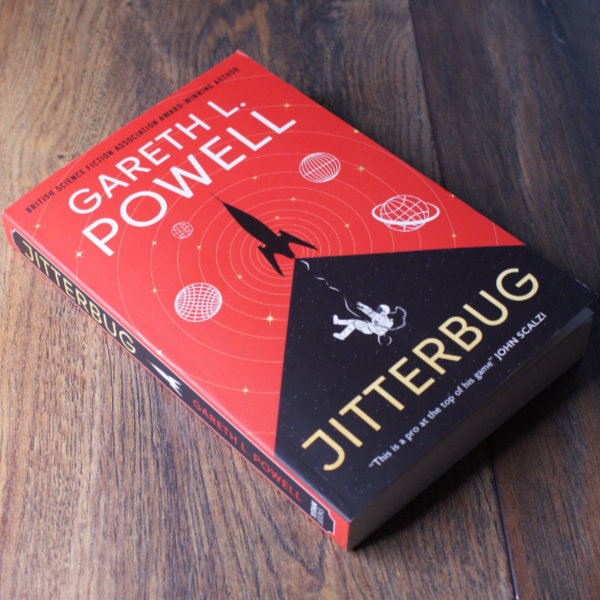 Jitterbug
 starts with a prologue in South London, on a rooftop where residents are watching as Saturn is slowly disassembled, just like Uranus and Neptune before it. After a certain amount of revelry and a tragic death, we leap forward to the story's "present day" and meet Copernicus Brown, a bounty hunter and captain of the ship Jitterbug.
In the space between the prologue and the time of the story, the disassembled planets have been formed into eight segments of a giant sphere - The Swirl - slowly orbiting the sun. These segments are habitable and have significantly more living area than the Earth, which is just as well as Mars is already being deconstructed like the outer planets before it.
The logic of the major reveal is rushed and doesn't stand up to any kind of analytical thinking. The maths of The Swirl don't appear to make sense.
Brown's crew is introduced: a wacky pilot, stoic engineer, an engineer's assistant, and - as this is a
Gareth L. Powell novel - a sentient A.I. housed in the ship.
Told from a first-person perspective, but shifting between various characters, you do need to pay attention to the chapter headings. I had to occasionally flick back a couple of pages to remember whose POV I was in, but it was largely easy enough to keep track of.
Slightly tangentially: Jitterbug appears to be the A.I. rather than the ship, yet the ship is called Jitterbug. At later points of the story there is talk of A.I.s being transferred to a different hull. Would that hull then become the Jitterbug, or would the Jitterbug then be living in the ship called something different? Anyway…
There's a distress call, Amber Roth is rescued, and once she boards the ship, everything becomes more complicated.
I enjoyed this novel. The worldbuilding is excellent, the characters are likable, and the observations regarding humankind's reaction to absolutely mind-blowing things happening around them feel completely plausible. If a significant portion of the solar system were destroyed and a habitable structure created, then of course it would take someone about five minutes to move in and plant a flag.
I do, however, have some significant issues with the book. There is a very real sense that Powell was given 300 pages and not a letter more, and that he struggled to fit in everything he wanted to say - or that needed saying - in the last third of the book. There is a reason
Liu Cixin novels need a sturdy bookshelf!
I can't address some of the issues without major spoilers, but there is a sacrifice made that - once you have all the information - means nothing. It was literally unnecessary except to maintain suspense. The logic of the major reveal is rushed and doesn't stand up to any kind of analytical thinking. The maths of The Swirl don't appear to make sense either. The given size of the segments and the material available in the outer solar system don't really tie together, but hand-wavy alien tech takes care of that.
4 stars for the story and the worldbuilding, but I really wish it were 500 pages, not 300. You could almost mark the page where everything starts feeling rushed.
Jitterbug by Gareth L. Powell is published by Titan Books.
If you purchase the book via one of the links in the shopping
basket, we may receive a small fee.